
The old framework for "healthy food" was built around restriction: low fat, low carb, low sodium. That framework is breaking down. A new one is emerging, defined not by what you eat less of, but by what your food doesn't contain and what it can do for you.
Brightfield Group's H2 2025 data shows this shift playing out in real time across both consumer behavior and social conversation.
Out With Old Restrictions
The numbers are stark. Keto, once a dominant force in wellness conversation, has seen its social share of voice fall nearly 59% since 2024. Low Fat and Low Sodium aren't far behind, each down roughly 50%. These are not cyclical dips; they are sustained downward trends.
For years, restriction was the dominant logic of healthy eating. Count the macros, cut the fat, limit the carbs. That framework gave brands a simple playbook. It also gave consumers a finish line they kept moving. This shift in consumer conversation suggests a deeper fatigue with restrictive, macro-focused frameworks. In the new landscape, simply having fewer carbs or less fat is no longer as compelling of a value signal on its own.
In With New Language: Quality and Free From
Consumers are still defining quality by what products leave out, but the specific exclusions have shifted from macronutrients to ingredients and processes. The top label claims consumers seek today reflect this clearly, with "No Added Sugar," "Made with Real Food Ingredients," and "All Natural" all ranking among the most sought-after in H2 2025 consumer data. Roughly a quarter say they are actively avoiding processed foods and reducing plastic use.
Consumers aren't just avoiding calories anymore. They're avoiding what they see as modern food risks.
This is showing up sharply in social conversation, where "Free From" claims have surged. Discussions around Seed Oils are up 341% over the last two years, alongside a huge rise in "Dye-Free" (+174%) discussions, an area where American regulations lag behind many other nations, aligning with concerns around Artificial Colors and Artificial Flavors which have also seen near triple-digit growth.
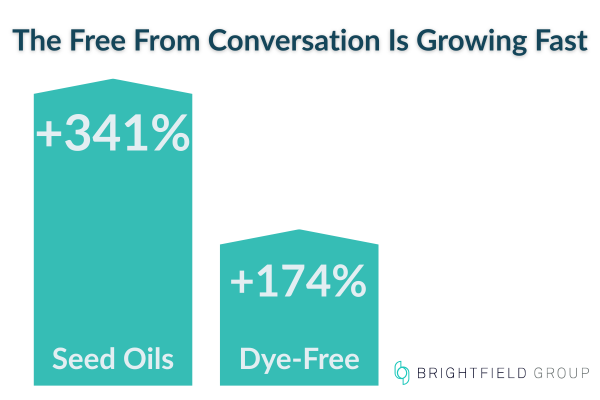
The pattern suggests consumers are moving beyond broad clean-label language toward more specific ingredient exclusions, particularly those tied to skepticism around processing methods and industrial inputs. These claims function as shorthand for a new kind of avoidance: not of calories, but of perceived modern food risks.
Trust and Functional Claims Rise
Removal is only part of the equation. Increasingly, consumers also want proof that what remains in a product is legitimate. Social conversation around "Clinically Backed" and "Evidence-Based" claims has grown nearly 392% and 188% respectively since 2024. Consumers are responding to proof-oriented cues, turning toward clinical substantiation, transparent formulation, and evidence standards as markers of legitimacy.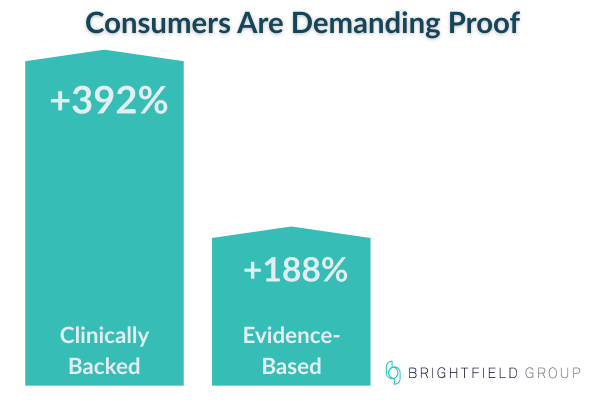
Trust isn't assumed anymore. It has to be earned with evidence.
Functional claims are moving in the same direction. High Protein and High Fiber rank among the fastest growing claims while Hormone Friendly has surged over 1,000% from a small base. Together, these trends point to consumers who want to know not just what's been removed, but what a product can do for them specifically: not general wellness, but personal, targeted outcomes.
What's Winning: Category Case Studies
These macro trends are showing up in specific categories, and the ones gaining ground share a common thread: they offer something functional, not just something removed.
-
Prebiotic Soda has seen double-digit year-over-year growth, reaching 5.7% incidence in Q4 2025. Consumers are drawn to its gut health benefits and low sugar content as a functional alternative to traditional soda, capturing both sides of the new consumer equation.
-
Protein Cereal has seen social conversation more than double year-over-year. Brands like Magic Spoon and Catalina Crunch are frequently mentioned, suggesting consumers are already forming preferences in a category that barely existed a few years ago.
-
Wheatgrass is a strong niche ingredient growing steadily in both consumer and social data. Found increasingly in powders, supplements, and smoothies, it appeals to a highly educated, upper-income consumer interested in plant-based approaches to immunity and digestion.
What This Means for Brands
The shift from macro-restriction to ingredient quality and functional benefit is more durable than previous diet trends. It's rooted in skepticism and trust rather than aspirational health goals, making it stickier. Rather than simply chasing the next diet, consumers are more fundamentally rethinking what their food standard baseline should be.
Brands still leading with "low fat" or "keto-friendly" positioning are increasingly talking past their most engaged consumers. The winners will be those that can credibly answer two questions at once: what's NOT in this product, and what can it DO for me?

Updated: 04/27/2026